The Vintage Artificial Intelligence Collection

“A curated collection of early computer software claiming some aspect of artificial intelligence as a primary feature, allowing the early interactions of humans and machines before things got a little strange. Includes a variety of programs intended as therapists, conversation partners, and opponents”. On Archive.org.

Supercut Database

A supercut is a tightly-edited montage of short video clips organized around a theme, often a recurring word, phrase, or trope from film or TV. It used to be everywhere online around 2007/8, and we also have a ton of examples coming from the artworld (think about the award-winning Christian Marclay’s 2010 installation The Clock). The term was coined by Andy Baio in a blog post on Waxy.org, with the help of Ryan Gantz. The name stuck. Since then, supercuts have appeared in countless places. Baio just resurrected his old repository and you can browse it here.
And if you want a deep dive into the history and the aesthetics of this genre of montage, you can watch Max Tohline’s 2021 video essay “A Supercut of Supercuts: Aesthetics, Histories, Databases“, an amazing video that traces back the genetic lines of experimental film, fan remix, documentary, news, and more, uncovering the roots of the supercut well before YouTube. “These multiple interlocking genealogies reveal that the supercut isn’t just a new form of compilation editing; rather, it’s a new way of thinking expressed by a mode of editing. In fact, the supercut is only a small part of a much larger story about a culture that traded one paradigm of knowledge and power, that of the archive, for a new one: the database“.

My favourites? The video collecting all the “dude” pronounced by Hurley in Lost and the monumental Palin’s Breath.

[via]

Cybernetics Image Library

Great resource, fascinating interface.

“Browse and contribute images of all kinds: diagrams, schematics, photos, graphic elements, and other visual fragments. Each image is linked to a record in the Cybernetics Library catalog or integrated from the project’s original are.na channel. Image tags and collections are inherited from the Cybernetics Library’s LibraryThing catalog. Collections are groups of resources based on previous library activities.”

Archives: Netizens and L’oading

I took advantage of these calm midsummer days to dig into my analog archive and reverse some material that otherwise would be lost. I’m very proud to show you what I found!
Here are some videos that document my first two exhibitions, both organized between the end of 2002 and the beginning of 2003. They’re television reviews, so sometimes the voice over tells naive or even wrong stuff, and they’re available only in italian, but nonetheless…
I was younger, slimmer and full of enthusiasm :-)

The first two videos are about “Netizens. Cittadini della rete” (december 2002), a small show I curated in a private gallery in Rome. The show was not just about net art, but about making art in the age of the Internet, and more precisely, it tried to demostrate how important was for this new community of young artists to share a citizenship: the web citizenship.
Artists: Cory Arcangel/BEIGE, Elout De Kok, Jodi.org, Limiteazero, Carlo Zanni
more info: http://www.netizensonline.it/2002

The third video is a review of “L’oading. Videogiochi Geneticamente Modificati” (Genetically Modified Videogames). This show was open from January to March 2003 at the Siracusa City Museum, in Sicily and it was, as the title suggests, about artistic modifications of videogames.
I’m particularly happy that this video exists because this exhibition didn’t have a catalogue, so there’s no documentation around, and I think it was a great project.
Artists: Mauro Ceolin, Brody Condon, Arcangel Costantini, Corby&Baily, Delire, Victor Liu See-Lee, Nullpointer, Chiara Passa, Retroyou, Gentian Skhurti
more info: https://www.valentinatanni.com/2008/07/2003-loading-videogiochi-geneticamente-modificati/

Enjoy the jump in the past :-)

An Image Bank for Everyday Revolutionary Life

David Alfaro Siqueiros (1896-1974), grandissimo artista messicano noto soprattutto per i suoi murales, collezionò, durante tutta la sua vita, una grande quantità di immagini fotografiche. L’archivio, consultabile online, contiene materiale che va dagli anni Trenta agli anni Settanta, in tutto sono circa 11.000 foto.
L’intento di Siqueiros era di lasciare in eredità un corpus di immagini che potesse ispirare anche gli artisti dopo di lui. Oggi una mostra presso RedCat, a Los Angeles, vede un gruppo di artisti alle prese con il lascito del grande messicano…

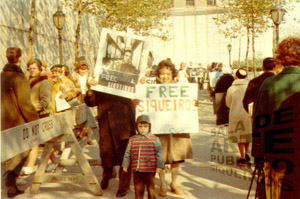
(nella foto: manifestazione per la liberazione di Siqueiros, allora in carcere, condannato ad otto anni per crimini politici. New York, 1962)

[via art.blogging.la]