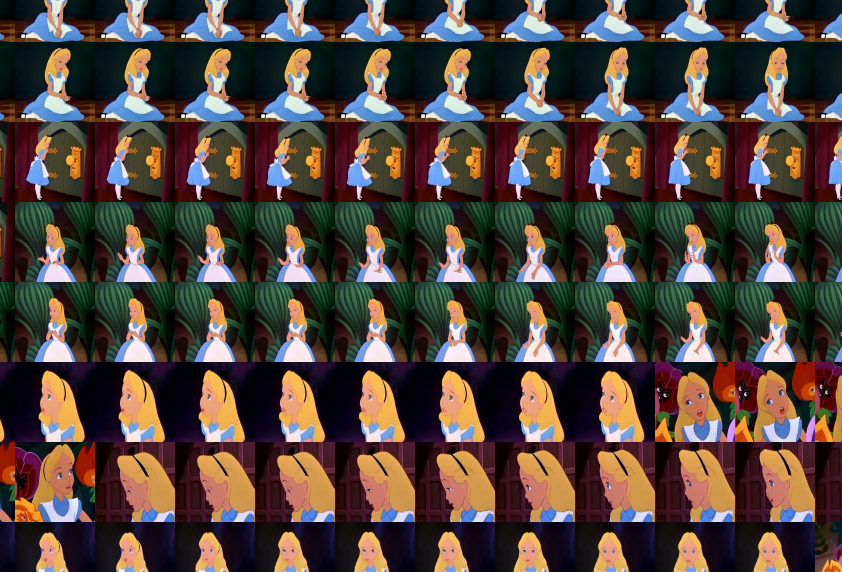
Supercut Database

A supercut is a tightly-edited montage of short video clips organized around a theme, often a recurring word, phrase, or trope from film or TV. It used to be everywhere online around 2007/8, and we also have a ton of examples coming from the artworld (think about the award-winning Christian Marclay’s 2010 installation The Clock). The term was coined by Andy Baio in a blog post on Waxy.org, with the help of Ryan Gantz. The name stuck. Since then, supercuts have appeared in countless places. Baio just resurrected his old repository and you can browse it here.
And if you want a deep dive into the history and the aesthetics of this genre of montage, you can watch Max Tohline’s 2021 video essay “A Supercut of Supercuts: Aesthetics, Histories, Databases“, an amazing video that traces back the genetic lines of experimental film, fan remix, documentary, news, and more, uncovering the roots of the supercut well before YouTube. “These multiple interlocking genealogies reveal that the supercut isn’t just a new form of compilation editing; rather, it’s a new way of thinking expressed by a mode of editing. In fact, the supercut is only a small part of a much larger story about a culture that traded one paradigm of knowledge and power, that of the archive, for a new one: the database“.

My favourites? The video collecting all the “dude” pronounced by Hurley in Lost and the monumental Palin’s Breath.

[via]

Cut-up as a magical process

burroughs

“What Bill [William S. Burroughs] explained to me then was pivotal to the unfolding of my life and art: Everything is recorded. If it is recorded, then it can be edited. If it can be edited then the order, sense, meaning and direction are as arbitrary and personal as the agenda and/or person editing. This is magick. For if we have the ability and/or choice of how things unfold—regardless of the original order and/or intention that they are recorded in—then we have control over the eventual unfolding. If reality consists of a series of parallel recordings that usually go unchallenged, then reality only remains stable and predictable until it is challenged and/or the recordings are altered, or their order challenged. These concepts led us to the realization of cut-ups as a magical process.”

– Genesis Breyer P-Orridge (Thee Psychick Bible)

[via]

A History of Political Remix Video (Before YouTube)

A History of Subversive Remix Video before YouTube: Thirty Political Video Mashups Made between World War II and 2005 – Curated by Jonathan McIntosh

“Filmmakers, fans, activists, artists, and media makers have been reediting television, movies, and news media for critical and political purposes since almost the very beginning of moving pictures. Over the past century, this subversive form of populist remixing has been called many things, including appropriation art, détournement, media jamming, found footage, avant-garde film, television hacking, telejusting, political remix, scratch video, vidding, outsider art, antiart, and even cultural terrorism.”

See the complete article and video collection via the Open Access online journal Transformative Works and Cultures:
http://journal.transformativeworks.org/index.php/twc/article­/view/371/299