I could watch Bobby Fingers‘ videos all day. This time, he made a diorama of when Michael Jackson’s hair caught on fire during the filming of a Pepsi commercial.
Roblox Car Crash Videos
I just found out that Roblox Car Crash Videos are a thing: “also known as BeamNG Roblox, refers to videos of car crashes taken in the video game Roblox, edited to replicate real-life dashcam car crashes by downgrading the quality and adding audio from car crash videos”. This trend is insanely weird (and good).
Never let yourself feel bad
A good description of this video by Jack Stauber can be found in the comments: “This man litterally take his nightmares and turn them into awsome songs”.
The Shape of All Stories
In this amazing lecture writer Kurt Vonnegut diagrams the shape of all stories: from Kafka’s “Metamorphosis” to “Cinderella”.
[via]
The LOL verifier

“The LOL Verifier is a device that sits between your keyboard and your computer and only lets you type “lol” if you’ve truly laughed out loud. Bringing authenticity to the least authentic place: the internet.”
by Brian Moore
Beware of the gnomes

I’ve been hearing about gnomes A LOT lately – even garden gnomes! – in the context of paranormal and horror stories. This painting by Woodrow White sums up the mood of this trend very well. Here is the video-inspo for the painting.
Smashing
This must be one of my favourite performance artworks of all time: Jimmie Durham, Smashing (2004).
“Wearing a suit, Jimmie Durham sits behind a desk like a bureaucrat performing his duty: smashing things. In an orderly manner, a person goes in, delivers an object, Durham smashes it with a prehistoric stone tool, violently but impassively. He stamps and signs a piece of paper as receipt and gives it to the same person, who goes off-scene. The same order of events is repeated several times during 92 minutes. This video-performance was part of Durham’s teaching residency at Fondazione Antonio Ratti in Como, Italy, in 2004.” – source
Learning to Learn
Since people talk so much about “machine learning” nowadays, I think we should go back to the basics and listen to the people who first began to investigate the idea. Here is the amazing Gordon Pask, English cybernetician and psychologist, interviewed by the BBC in 1974. Here you can find one of his best writings, here is a good article about his concept of “maverick machines”, and here is a video lesson about him by Paul Pangaro.

Meet DAN

The Seventh Seal Zoomer Edition

Piper Page uploaded a full version of The Seventh Seal (1957) by Ingmar Bergman onto Youtube with oddly satisfying videos on the left and Subway Surfers on the right. My head hurts but my heart is happy. Watch it here.
This is What I call Extreme Art
Cat Graffam recreated “Judith Beheading Holofernes” by Caravaggio using Kid Pix Studio, a software released in 1995. Using the MOUSE. It was painful to watch at times, but amazing.
The Salt and the Women
A film assembling music produced by mushrooms. Text from GPT3 and images from Stable Diffusion. By Eryk Salvaggio. Read more about it here.
The Internet Aesthetics Spiral: #corecore
“Corecore refers to an aesthetic that’s prevalent on TikTok under the hashtag “#corecore,” specifically within so-called NicheTok circles of NicheTokers, that plays on the -core suffix by making a “core” out of the collective consciousness of all “cores.”
[via]
Ghostwriter
Designer and engineer Arvind Sanjeev created Ghostwriter, a one-of-a-kind repurposed Brother typewriter that uses AI to chat with a person typing on the keyboard. The “ghost” inside the machine comes from OpenAI’s GPT-3, a large language model that powers ChatGPT. The effect resembles a phantom conversing through the machine.
[via]
I took apart my old typewriter and powered it using @OpenAI GPT-3.
Meet: Ghostwriter, an #AI creative writing companion that lets you co-write stories on paper with #ArtificialIntelligence + . pic.twitter.com/t8rP9AW51q
— Arvind Sanjeev (@ArvindSanjeev) December 1, 2022
Mestre Ensinador
“Me When I Was A Baby, also known as Whimsical Little Creature, refers to videos of the TikTok account MestreEnsinador1. It features videos of a flying white puppet wearing a green hat named Tiburcio. The name translates to “master teacher” in Portuguese, with the gnome puppet being referred to as a “forest being” by the TikToker in his comment sections. The videos often show the puppet flying and twirling, sometimes doing a little dance and sometimes undertaking mysterious rituals. Maestre Ensinador went viral in the fall of 2022 after a series of duets where people showed his videos to their younger siblings and tried to convince them that the puppet was them as a baby.”
“Tibúrcio is a strong gnome,” Jhonatan Oliveira says, once belonging to his late grandmother, “and that’s why I like it very much.” He remade the puppet’s body three years ago, before he began making the videos. His uncle appears with him in the first viral TikTok — he’s the one who took Tibúrcio out of the cruse, an earthenware vessel that Oliveira refers to as a buried treasure. “But, he is not a cash treasure, but a spiritual one,” he explains. “The inspiration to make the videos comes from God!”
If you die in the game, you die in real life

Palmer Luckey, the man who created the Oculus rift, made a VR Headset that kills the user If they die in the game.
“The idea of tying your real life to your virtual avatar has always fascinated me – you instantly raise the stakes to the maximum level and force people to fundamentally rethink how they interact with the virtual world and the players inside it. Pumped up graphics might make a game look more real, but only the threat of serious consequences can make a game feel real to you and every other person in the game. This is an area of videogame mechanics that has never been explored, despite the long history of real-world sports revolving around similar stakes.”
[via]
A Hollow Frame of Paradise
“Sand pours through his fingers as he tries to gather his flame together. His people. But it is dying, and they are dead. Extinguished.”
Jolene +
The Infinite Conversation
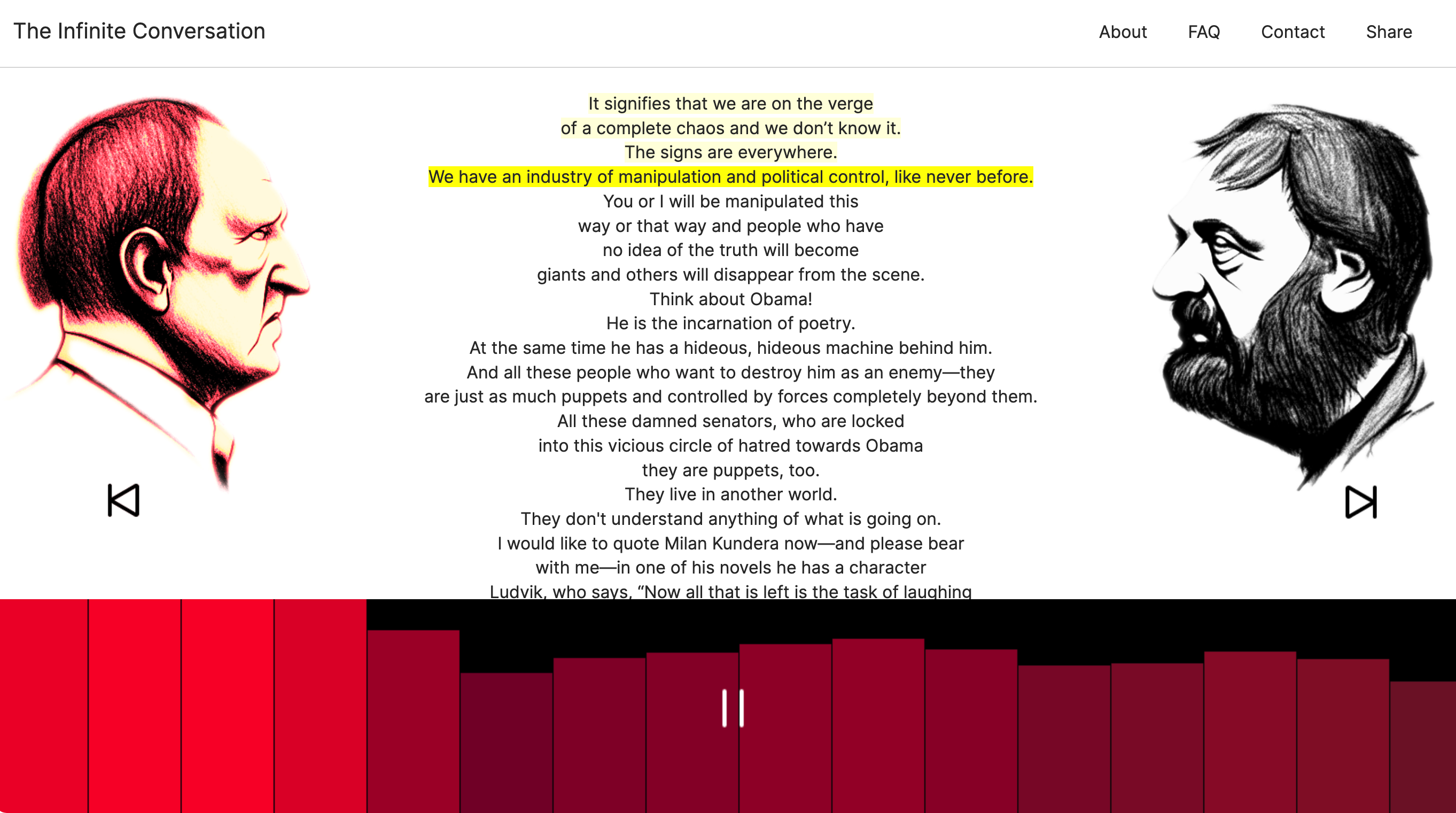
“An AI generated, never-ending discussion between Werner Herzog and Slavoj Žižek. Everything you hear is fully generated by a machine. The opinions and beliefs expressed do not represent anyone. They are the hallucinations of a slab of silicon.”
Cornerfolk
A single-episode analog horror video, Cornerfolk concerns a man who believes strange entities to be using his home as a sort of nexus when passing through dimensions. Fascinating.
A neural network mimicking a video game

Ollin Boer Bohan made an interesting experiment involving videogames and AI:
“I made a playable Pokémon overworld. It looks (mostly) like a normal video game, and you can try it in your web browser here. Although this looks like a video game, I did not write any game code. This program is actually a neural network mimicking a video game.”
Something called the internet
“Kate Bellingham reports that an exciting new interconnected world – a world where every word ever written, every picture ever painted and ever film ever shot will be at our fingertips – is tantalisingly close. The information superhighway will be a high-capacity digital communication network, which in time could revolutionise the way we shop, socialise and work”.
AI for detecting cluster munitions
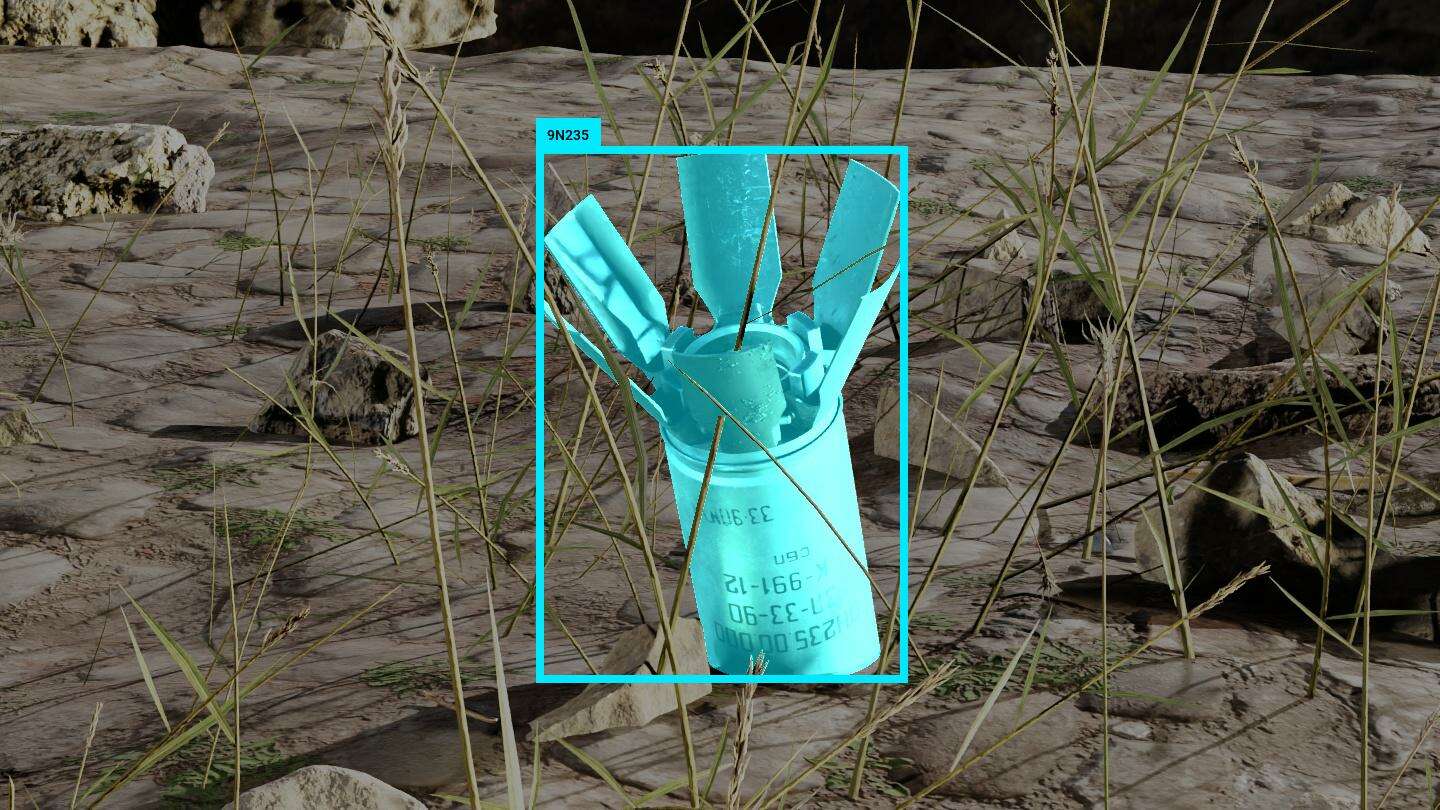
VFRAME is an organization that researches and develops state-of-the-art computer vision technologies for human rights research and conflict zone monitoring. It is developed and maintained by Adam Harvey in Berlin with contributions from Jules LaPlace, Josh Evans, and a growing list of collaborators.
During the winter/spring of 2022 VFRAME and T4T partnered to develop a 3D model of the 9N235 submunition that has frequently appeared in the war in Ukraine. This model is being used to create synthetic training data for object detection algorithms and high-accuracy 3D printed replicas for benchmarking purposes.
Everyone lives out a fairytale as a template script
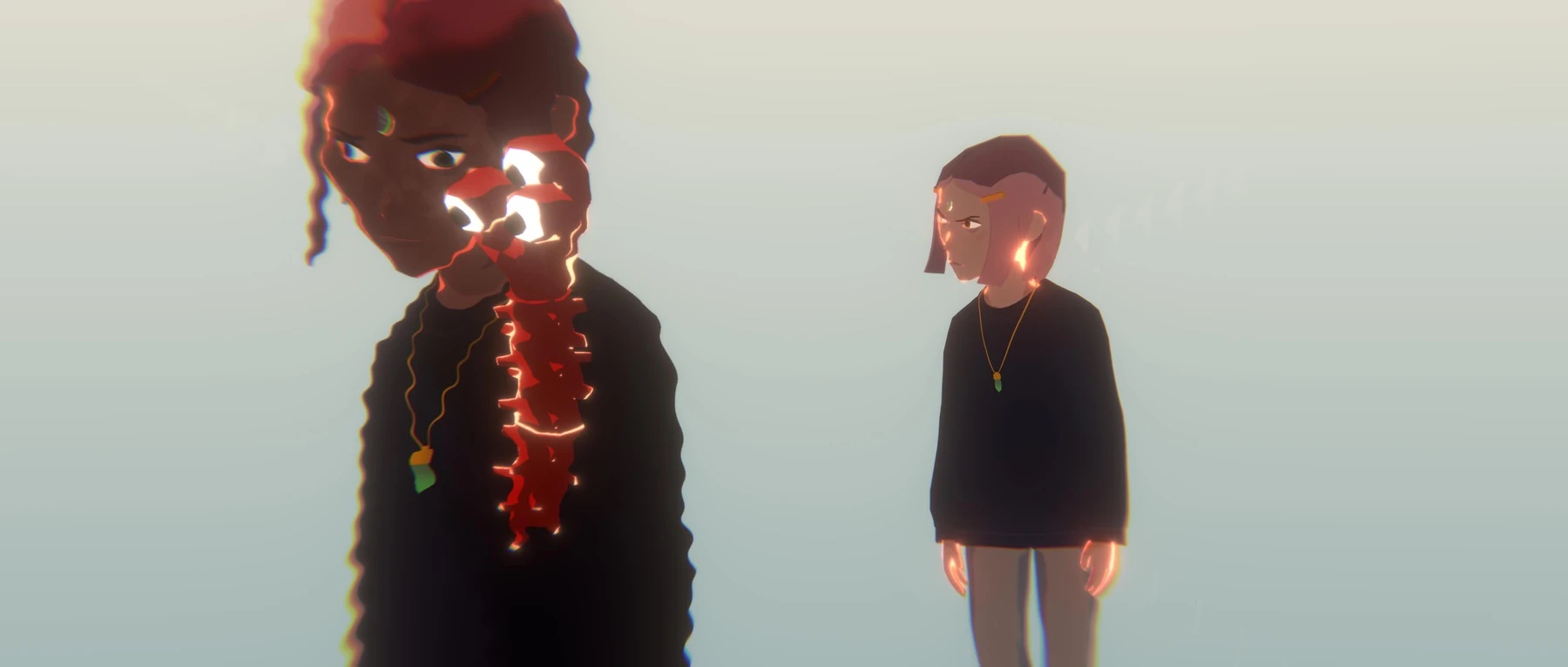
Artist Ian Cheng looks at the way that the work of psychiatrist Eric Berne changed the way that he thought about human personality when it came to creating the AI simulations that people his work. On Elephant:
“Obviously we take different paths, but Berne believed that everyone lives out a fairytale as a template script that they’ve cast themselves into with the help of their parents. Most people aren’t satisfied with the script that they’re unconsciously barreling down. It might be a mismatch: maybe your parents had old fashioned values; maybe the culture you grew up in radically shifted in your teens, which alters the relevance of your life script.”